


A prescription can go into translation glasses: INMO GO3 has official custom prescription lenses that clip into the frame and sit close against the display lenses, so corrected vision and translated subtitles come through one pair. These lenses are made for nearsightedness (SPH) and for nearsightedness combined with astigmatism (SPH + CYL). Before ordering, gather the sphere, cylinder and axis values for each eye, your pupillary distance (PD), and a choice of lens index from 1.6, 1.67 or 1.74.
An eye test slip uses compact labels and signs that are easy to misread. PD is often missing from it, and the three index options look like strength figures when they describe the lens material. Sorting out those three points on paper before checkout means the values you submit match the eye test they came from.
Reading the Values on Your Eye Test Slip
An eye test slip for glasses lists each eye on its own row, usually marked R and L, or OD and OS, with columns for SPH, CYL and Axis. Each column answers a different question about how a lens needs to bend light for that eye, and the GO3 lens order asks for the same values eye by eye. Because every row belongs to one eye, a value moved to the wrong row ends up describing the wrong eye.
| Field | What it describes | How it reads on the slip |
|---|---|---|
| SPH (sphere) | Overall lens strength; a minus sign indicates correction for myopia | The sign is part of the value; "PL" or "plano" here means no sphere correction, and any CYL and Axis on the same row still apply |
| CYL (cylinder) | How much astigmatism the lens corrects | "DS" in this column means no astigmatism |
| Axis | The angle at which the cylinder power is set | Only meaningful together with the CYL value of the same eye |
| PD | Distance between the centres of the pupils | Written as one total figure or as one figure per eye |
Dropping the minus sign from an SPH value turns a correction for nearsightedness into its opposite, and a CYL value read with the other eye's axis corrects astigmatism in the wrong direction, so the sign and the pairing carry as much information as the number beside them. CYL and Axis describe a single correction between them, one giving the amount and the other the direction; read apart, neither value says much.
The two supported types, nearsightedness and nearsightedness with astigmatism, are identified by reading all the values on the slip together, not by which columns happen to be filled in. The optometrist who carried out your eye test holds the full examination record and can explain any abbreviation on it. A dispensing optician, who fits glasses but does not run the eye test, is the person to ask about PD and lens choices.
Pupillary Distance: The Measurement Your Slip May Leave Out
PD is the distance between the centres of your pupils when you look at something far away. Lens makers use it to place the optical centre of each lens directly in front of each pupil. A lens centred in the wrong place can create unwanted prismatic effects, and those are linked to eye strain, headaches and blurred or double vision. On translation glasses, where you read lines of subtitle text through the lens during a conversation, that centring matters as much as the lens power.
PD is usually taken as part of fitting glasses and is often left off the written result of the eye test; in the UK, there is no legal requirement to print it there. When your slip has no PD figure, it can be measured during the eye test appointment or by a dispensing optician when glasses are fitted.
The GO3 order takes PD either as a single total or as two figures, right eye then left. Two figures (often written like 31/32) give each eye's distance from the centre of the nose separately, which matters when the eyes sit at slightly different distances from the bridge. Adding two figures into one total keeps the overall width but drops that per-eye detail, and the two-figure option exists to carry it through to the lens maker.
Choosing Between 1.6, 1.67 and 1.74 Lens Index
The three index options are not thicknesses in millimetres and not lens powers. Refractive index describes how strongly a lens material bends light. A higher-index material reaches the same correction with less material, so for the same correction and lens design a 1.74 lens can be made thinner than a 1.6 lens, with 1.67 in between.
Nearsightedness shows up as a minus sign on the SPH line, and a stronger correction shows as a larger number after that sign: -4.00 corrects more than -1.50. Minus lenses are thicker at the edges, and the edge grows as the correction gets stronger. That is why the thickness difference between the three index options also grows with the strength of the correction, and why the index question gets more attention from wearers with stronger corrections.
Lens shape and weight enter the same material decision as thickness, so the choice weighs all the values on the slip and not the SPH figure alone. The dispensing optician who measures your PD can tell you which index they would normally pick for your values and what that choice changes at the lens edge.
How the Lenses Sit in INMO GO3 and What You See Through Them
The custom lenses clip into GO3 and fit closely against the display lenses. The correction sits between your eyes and the display, so both the subtitle text and the room in front of you come through the same corrected optics. In daily use, one frame does both jobs, with no second pair of glasses to put on before a conversation and no stacking of frames on your face.
With the lenses fitted, translated subtitles still appear on the display lenses, bilingual mode places the original line next to the translation, and in meetings INMEET shows live transcription in front of you. Bilingual mode is the one to use for checking a name, a figure or a technical term against what was actually said, and that small text is read through the same corrective lenses as everything around you.
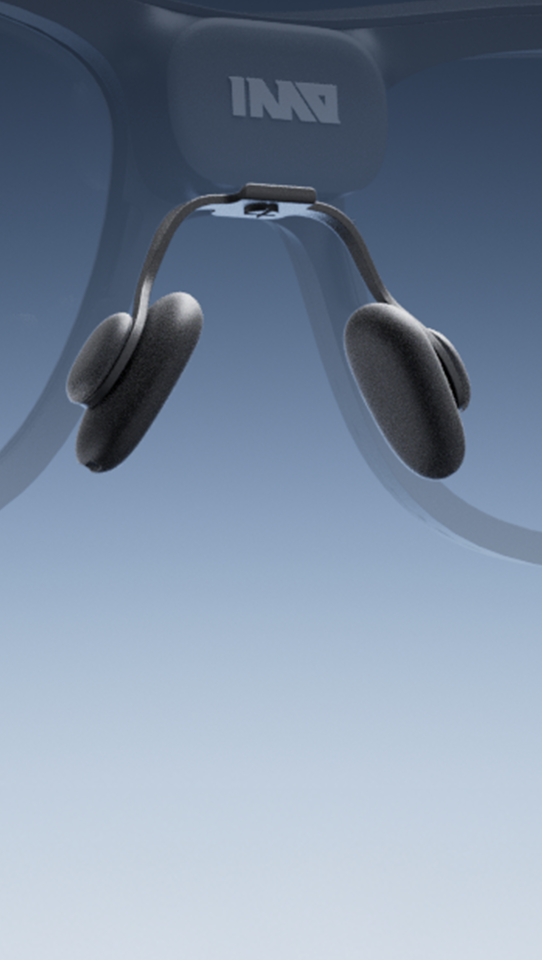
Fit around the corrective inserts comes from Air Cushion Nose Pads at the bridge and temples that each open outward by 15°. Long sessions in the frame are discussed in a separate piece on translation glasses for long meetings. Anyone planning to wear GO3 as everyday eyewear can also read about smart glasses that look like normal glasses at work.
What Should You Check Before Ordering Custom Lenses?
Check the test date, your PD, the values for each eye and the lens index, then plan back from the date you need the glasses. With the slip next to the order form, the sequence follows the steps on the lens order page:
- Look at the test date on your slip. The order asks for an eye test within the past year; if yours is older, book a new test and ask for PD to be measured at the same appointment.
- Have PD in writing, either as one total figure or as two figures, right eye then left. Two figures go into the two-PD option in the order written.
- Copy SPH, CYL and Axis for each eye, right eye first, with every sign and notation as written, or prepare a copy of the slip with PD included.
- Choose the lens index: 1.6, 1.67 or 1.74.
- Count about 7 working days of production plus the shipping window back from your date, then submit the details, place the order and confirm receipt when the lenses arrive.
The one-year requirement applies to this custom order because the lenses are made from the values you send, so those values need to reflect your current vision. Production and shipping are separate stages, and a trip, a course or a set of meetings on a fixed date is the deadline both of them count back from.
A saved copy of the exact values and index you submitted lets you hold the next eye test slip against them line by line, and that comparison shows straight away which eye and which field changed since your current lenses were made.
FAQ
Can I wear INMO GO3 over contact lenses?
GO3 is also available without corrective inserts, and that setup can be worn over contact lenses. It suits people who already rely on contacts through the day, and it skips the custom lens order along with its production time.
Can I use my contact lens prescription for the order?
The GO3 order works from a glasses prescription, because the custom lenses are spectacle lenses held in the frame. A contact lens prescription is written for a lens that rests on the eye, and it carries fields a glasses order has no place for, such as base curve, diameter and the lens brand or material. Wearers who only keep a contact lens prescription on file can ask their optometrist for the glasses prescription from the same eye test.
Who can confirm that my values fit the lens options?
You can send a copy of your slip to support@inmo.com before ordering, and the team will confirm which options fit it. Slips with handwritten entries, or with labels that differ from the usual SPH, CYL and Axis layout, can be checked this way before the order goes in.
Share:
Smart Glasses on iPhone vs Android: What Stays the Same on INMO GO3 and What to Check
Can Smart Glasses Translate Phone Calls and WhatsApp Calls? What Works With INMO GO3