

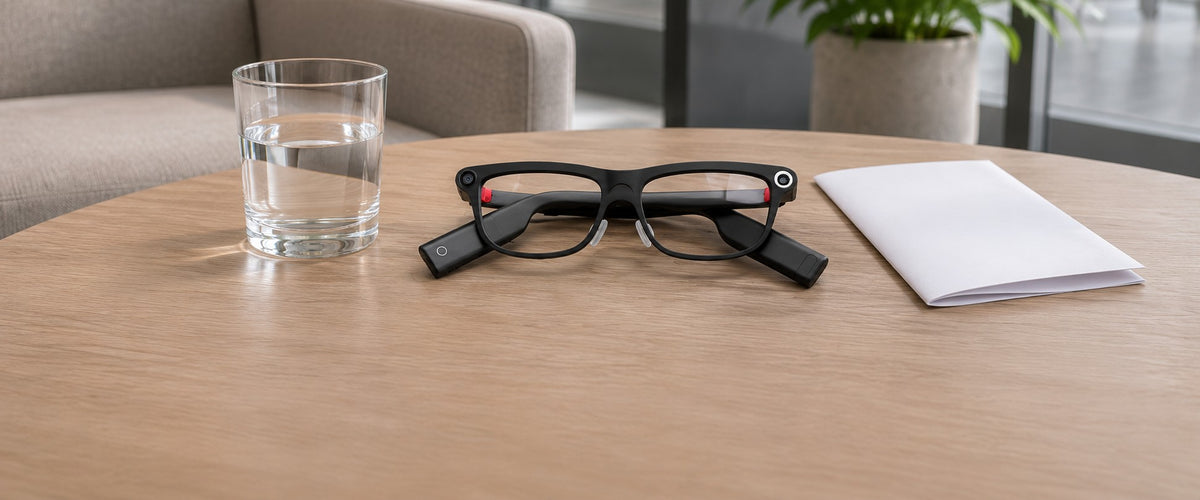
A written interview answer works best as a rehearsal tool when you speak it aloud and then remove the words in stages. Teleprompter glasses for interview practice fit that method: INMO GO3 shows your prepared answer on its lenses while you speak toward a laptop camera or a mirror. Practice one STAR answer as a full script, then as key points, then as a few keywords, and move to the next stage when the current one holds up.
Why Each Round Takes Words Away
Interview answers are judged as speech, so the skill you need on the day is pulling up a story and phrasing it on the spot. Reading a full script aloud practices something narrower, with your eyes following sentences you already wrote. The later rounds are there to practice the on-the-spot version, giving each STAR part a point you can pick the story up from when an interviewer asks you to go back to one detail or explain a decision.
Round one settles the content: which example you use, what you were responsible for, what you did and what changed. Round two keeps only the order of those parts, so the sentences have to come from you. Round three keeps one word per STAR part as a cue for where the story goes next. Because GO3 places the text in your forward view, each round also gives you practice at keeping your head up toward a camera or an interviewer, with no notes on the desk to glance down at.
One STAR Answer Written Three Ways
STAR stands for Situation, Task, Action and Result, and it gives a behavioral answer an order a listener can follow: the context, what you had to achieve, what you personally did, and how it turned out. Action carries the most weight because it shows how you work, so it keeps the most room in every version below. Every bracket is a slot for your own experience; fill them all from one real example you can discuss in more depth if asked.
Round one, the full script, answering "Tell me about a time you got a project back on track":
> In [role], I was responsible for [project] when [problem] put [deadline or goal] at risk. My task was to [what you had to achieve] while keeping [standard you could not drop]. I [first action], then [second action], and [the action that shows your judgment]. As a result, [real outcome with a figure or concrete change]. Since then I [what you now do differently].
Round two, the key points:
- Situation: [role], [project], [problem]
- Task: [what you had to achieve], [standard]
- Action: [first action], [second action], [judgment action]
- Result: [real outcome], [what you now do differently]
Round three, the keywords:
> [problem] / [goal] / [judgment action] / [outcome]
Each round-three keyword stands for one STAR part, and the Action word should come from the step that shows your judgment, since that step carries the weight of the answer. Cut the background first and keep one sentence of context for the listener, while the Result keeps its figure through round two so the answer has a clear ending to aim for. The bracketed slots stay identical across all three rounds, so any gap you notice later points to a specific part of your own story.
How Do You Set Up Teleprompter Glasses for Interview Practice?
All three versions can sit in the Teleprompter section of the INMO Global app, where you write and edit scripts directly, and iPhone users can bring in an existing Word, PDF or TXT document as well when the answers were first drafted elsewhere. Saving each round as its own entry lets you drop back to an earlier version for a story that is not holding up yet.
- Open Teleprompter in the INMO Global app, select the top-right icon, and choose + to start the round-one script.
- Add the round-two and round-three versions the same way, opening each with the question and the round number.
- Tap Start Teleprompter to show the script on the lenses.
- During round one, enable auto page turning on your phone so the text scrolls with your voice.
- In rounds two and three, slide the touchpad on the right temple or tap the ^ icon in the app to turn pages yourself.
Auto page turning follows your voice in the seven languages that GO3 voice-following covers, which leaves round one free for attention to pace while the full script moves along. Rounds two and three hold so few words that you are speaking more than reading, and turning the page yourself lets you decide when each STAR part is finished before the next cue appears. If your pace rises as the text thins out, the guide to pauses and speaking speed on teleprompter glasses covers keeping rhythm.
Watching Each Round Back on Camera
Set up the laptop or phone you would use for a video interview, keep your gaze on its camera lens while you speak, and record every round on that device; for an in-person interview, a mirror or an empty chair gives you the same target. With the answer on the GO3 lenses and nothing on the desk, the recording shows whether your eyes stay level between sentences. The guide to keeping eye contact while reading a script explains where to break lines so you reach the end of a phrase before looking up.
Play back rounds two and three with the round-one script open beside you, and check each STAR part in turn. Did the Task still say what you had to achieve, did the Action keep the step that shows your judgment, and did the Result keep its figure? A part that drops out needs a word added back to its prompt. If a part comes out sentence for sentence in round-one wording, try that part with one word fewer next time.
A Rehearsal Log for Each Answer
Keep one row per run in a notes app or spreadsheet, listing the question, the round, what went missing and the change you will make before the next attempt.
| Question | Round | Prompt on the lens | What went missing | Change before the next run |
|---|---|---|---|---|
| Project back on track | 1 | Full script | Result read too fast | Add a pause mark before the Result |
| Project back on track | 2 | Key points | Second action left out | Give that action its own line |
| Project back on track | 3 | Keywords | Result said without its figure | Put the figure in the Result keyword |
| Disagreement with a colleague | 2 | Key points | Situation ran long | Cut the background to one line |
Write the last column as an edit to the prompt itself: a word added, a line cut, a pause mark moved. After two or three rows for a story, compare them to see whether the trouble sits in one STAR part or runs across the whole answer, and use that to pick the branch in the next section.
Planning the Next Practice Session
Read the log before each session and follow the branch that matches each story; three to five answers make a workable block for one sitting.
- If the same STAR part drops out of round three on two runs, go back to round two for that story only.
- If a story holds up in round three on two runs, tell it once with nothing on the lens, then answer a follow-up you have not rehearsed, such as what you would change next time.
- If that unrehearsed follow-up stalls, write the follow-up as a new question in the log and give it its own short STAR outline.
- If two stories start sharing keywords, give each a distinct Action word so they stay apart when a question could fit either.
Give stories that already pass the no-prompt run a short spoken run-through the day before the interview, and spend more of each session on whichever story has the most rows in its log.
FAQ
Can I use teleprompter glasses in a recorded video interview?
The interview itself follows the instructions each employer sends, so GO3 belongs to the preparation stage: rehearsing on the same laptop, camera angle and lighting you will use for the real recording. If the format sets a time limit per answer, time your round-three version against it. For framing and on-camera setup, see the guide to teleprompter glasses for talking-head videos.
Should all three rounds be written in the interview language?
Writing round one directly in the interview language works well with GO3, whose voice-following page turns cover seven languages, so the full-script round runs hands-free when your interview language is one of them. Build the key points and keywords in that language too, so each run has you recalling the story there and not translating it from your first language mid-answer.
How many interview questions should I rehearse this way?
Five to eight STAR stories is a practical starting point, because one story can answer several questions: a story about meeting a tight deadline can also speak to pressure, prioritizing and teamwork. Map each story to the questions it fits, spend the three rounds on the stories, and add a new one only for a skill the job description stresses that none of your current stories shows.
How do I keep a rehearsed answer from sounding memorized?
Tell the same story at two lengths, roughly 30 seconds and two minutes, using only the round-three keywords for both. Then start it from a different STAR part, opening with the Result and working back to the Situation. Reshaping the answer from a few words keeps you choosing the sentences in the moment, which is how conversation sounds.
Share:
AR Glasses With Screen Recording: How INMO AIR3 Captures Demos and Tutorials
Smart Glasses With Camera and Display: What INMO AIR3 Can Capture